Feeds:
Posts
Comments

Crispy Pata

Crispy Pata

Crispy Pata

A recent survey asking Filipinos what they thought the national dish of the Philippines should be, revealed that 90% of respondents voted for crispy pata.  While adobo is probably the first dish you learn how to cook, the crispy pata was voted all time favorite.

Well, before I am asked to reveal the survey methodology, I have to admit that the survey was done at my dining table, while we were feasting on crispy pata that I made for one Sunday lunch.

Crispy Pata is a deep fried pork leg which is usually served with a soy/vinegar dipping sauce or sometimes a liver sauce.  The pork leg is first simmered until tender and then dried at least overnight.  The final step is the frying which really requires (in my opinion) a deep fat fryer.  Some recipes call for the pork leg to be fried sometimes as much as three times.  The process of simmering the meat and then frying ensures crispy crackling on the outside yet very tender meat.  The recipe below is a simplified version but delicious nevertheless!

This recipe serves 8 people.

Ingredients

  • 3 pork legs, singed to remove any hair
  • 1/4 cup fish sauce (patis)
  • 2 bay leaves
  • 5 whole peppercorns
  • 1 onion, roughly chopped
  • Oil for deep frying

Procedure

  1. Fill a pot with water and the pork legs.  Bring to a boil and remove any scum that floats to the top.
  2. Drain the pot and fill anew with water and the pork legs.
  3. Add the rest of the ingredients and bring to a boil.  Once the water boils, bring down the heat and simmer for around 2 hours until tender.
  4. Remove the pork  from the heat and cool.
  5. Place the pork in a place and cover loosely with foil and leave in the refrigerator at least overnight to allow the pork to dry out (this is essential to get the crispy skin).
  6. Just before serving score the pork legs with a sharp knife.
  7. Heat the oil to 190C and carefully lower the pork legs into the oil.
  8. Fry until crispy, around 10 minutes.
  9. Serve with either the soy/vinegar dipping sauce or lechon sauce and PLENTY OF RICE!

Soy Vinegar Dipping Sauce

Mix equal quantities soy sauce and white vinegar (preferably a Filipino brand like Datu Puti) and add a crushed garlic or a chilli.

Apple Tart

Apple Tart

DSC_0145

Some years ago, I swore that I would never eat another apple related dessert as long as I lived.  The reason being my eldest sister (By the way, 09-09-09 – HAPPY BIRTHDAY SIS!) had an apple pie business.  She used to sell apple crumble pies and she used our kitchen as her headquarters.  So while at first we enjoyed the fact that we would have unlimited access to apple pies, after awhile, it just all became too much.  The turning point was when I went to school and my classmate asked me why I smelled like oatmeal – a core ingredient in the crumble… (until then I did not realize oatmeal had a distinct smell).

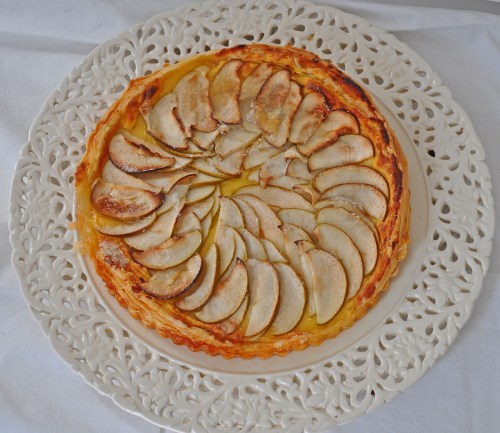
Recently, I decided the humble apple deserved a second chance.  I was intrigued by a recipe in Giorgio Locatelli’s Made In Italy Food and Stories Cookbook.  He calls it Torta di Mele and it consists of a puff pastry base, a generous layer of pastry cream and finally slices of Granny Smith apples.   I have altered it to suit my taste.

This recipe makes four 10 cm tarts or one 28cm tart.

  • 1 package (375 grams) puff pastry (I used the Careme Brand)
  • 4 Granny Smith apples
  • 4 Tablespoons caster sugar

For the Pastry Cream

  • 70 grams caster sugar
  • 75 grams cornflour
  • 6 egg yolks
  • 300 ml milk
  • 200 ml cream
  • 1 cinnamon stick
  • 1 vanilla pod

Pastry Cream

  1. To make the pastry cream, mix the sugar, cornflour and egg yolks together in a bowl until pale.   Put the milk and cream in a pan with the cinnamon stick and the beans scraped from the vanilla bean.  Bring the milk mixture to a boil and then take off the heat and leave to stand for 20 minutes for the flavours to infuse.
  2. Slowly whisk the milk mixture into the sugar and egg yolk mixture.  This is now your pastry cream mixture.  Pour this back into the pan used to heat the milk and continue to whisk until the mixture thickens.
  3. Take the mixture off the heat and remove the cinnamon stick.
  4. Cool the mixture in the refrigerator.
Spread the pastry cream over the puff pastry

Spread the pastry cream over the puff pastry

For the Tart

  1. Preheat the oven to 180C
  2. Roll out the pastry into four circles of 10 cm diameter or one 30 cm diameter around 3 mm thick.  Prick all over with a fork.  Spread with pastry cream.
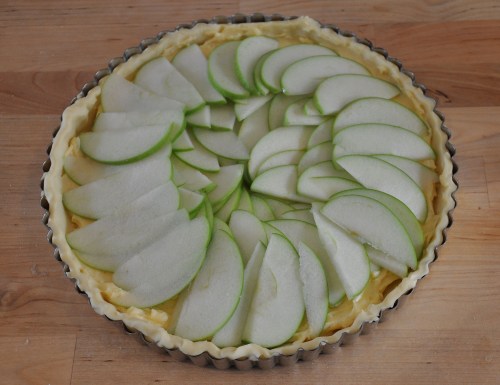
  3. Halve the apples and remove their cores.  Slice them 2 mm thick and arrange them in concentric circles, embedding them in the pastry cream.DSC_0090
  4. Put in the oven for 20 to 30 minutes (another 5 minutes for the larger tart) until the pastry is golden and crisp.  Halfway through the baking time, sprinkle with caster sugar, which will melt and caramelize.  If the apples look to be cooking too quickly, add some more sugar.  This will act as a barrier to the heat.

Bibingka

Bibingka

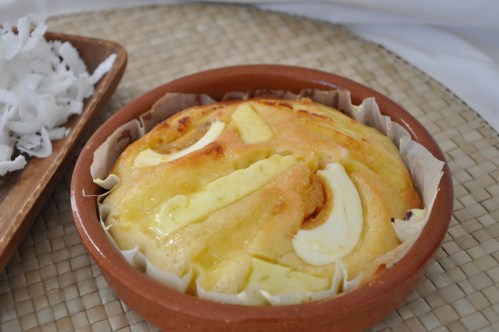
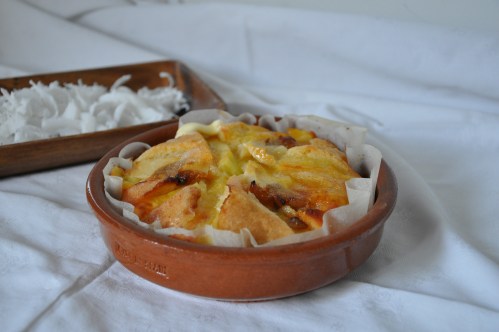
Bibingka - A Philippine Favourite!

Bibingka – A Philippine Favourite!
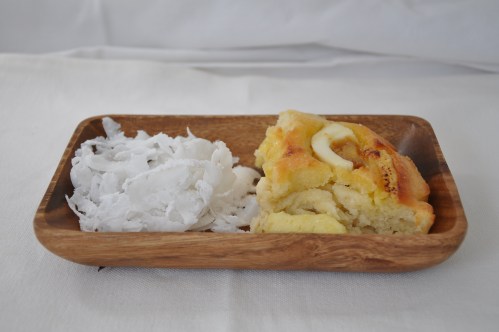
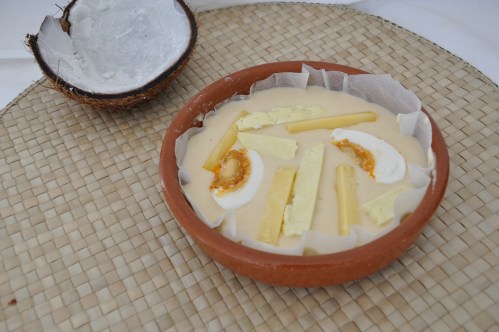
Best served with freshly grated coconut

Best served with freshly grated coconut

Why is she talking about Christmas in September?!?  If you aren’t Filipino or if you have never spent Christmas in the Philippines you probably wouldn’t understand.  You see, Filipinos are notorious for having the longest celebration for Christmas.  Once the “ber” months roll around (September, October, November etc) we start playing Christmas music and the decorations start to come out.

So to kick off the Filipino Christmas Season, here is a recipe for one of my favourite treats – Bibingka.

Every morning starting the 16th of December until the 24th, churchgoers all over the Philippines wake up before the crack of dawn to hear mass.  This is one of the most enduring traditions in the Philippines called Simbang Gabi.  After mass, friends and family gather in their homes to feast on traditional Philippine breakfast treats.  One of the more popular dishes is Bibingka.  It’s a sweet/savoury cake made from rice flour, coconut milk, flour and eggs.  It is topped with a native Philippine cheese and salted duck eggs.   Admittedly it was an effort to grind my own rice and grate my own coconut but I had a bad craving for a really authentic bibingka – and it was worth it!

This recipe was adapted from Memories of Philippine Kitchens (Amy Besa and Romy Dorotan).

Ingredients for Galapong (rice batter)

  • 1 3/4 cups jasmine rice

Ingredients for Bibingka

  • Softened butter for the clay cazuelas/containers
  • Four 6-inch banana leaf rounds, if unavailable use wax paper
  • 1 1/4 cups flour
  • 1/4 cup plus 4 tablespoons sugar
  • 1 tablespoon baking powder
  • 1/2 teaspoon salt
  • 1 1/2 cup galapong
  • 4 eggs
  • 1 cup coconut milk
  • 2 salted eggs
  • 4 slices sharp cheddar cheese
  • 4 slices kesong puti (I used Haloumi as kesong puti is a traditional Philippine cheese unavailable in Australia)
  • 4 tablespoons melted butter
  • 1 cup freshly grated coconut

For the galapong

Rinse the rice under cold running water until clear.  Drain and place in a bowl with cold water to cover and leave in the refrigerator overnight.  Drain and rinse again and then drain in a colander for 30 minutes.  Transfer to a food processor and process until the mixture is finely ground, about 1 minute, scraping the sides of the processor as needed.   To grind more thoroughly, use a coffee/spice grinder and grind 2 or 3 tablespoons at a time.  You will need 1 1/2 cups galapong.

For the Bibingka

  1. Pre-heat the oven to 220c (fan forced).  Brush the cazuelas/containers with softened butter and line with the banana leaves or wax paper.
  2. Sift the flour, 1/4 cup sugar, baking powder and salt into a bowl.  Add in the galapong.  With a whisk, beat the eggs and coconut milk in a separate bowl.  Pour into the dry ingredients and with a rubber spatula, mix slowly until smooth.
  3. Divide the mixture among the lined containers, nestle the duck eggs (I used half a duck egg per cake, quartered), cheddar cheese strips and kesong puti and finally 1 tablespoon sugar per cake.
  4. Set the cakes on the top rack of the oven and bake until firm, around 15 minutes.
  5. Brush the bibingka with the melted butter while still warm.  Unmold each bibingka onto a serving plate.
  6. Serve with grater coconut.
The Bibingka batter before baking

The Bibingka batter before baking

To Open a Coconut

Pierce the eye of the coconut with a skewer and shake out the water from the coconut.  Heat the coconut in a 200C oven for 10 minutes until the coconut cracks.  Remove the coconut from the oven and finish opening the coconut by holding the coconut and hammering it until it opens.  Remove the meat with a melon baller.

Croquetas de Pollo

Croquetas de Pollo

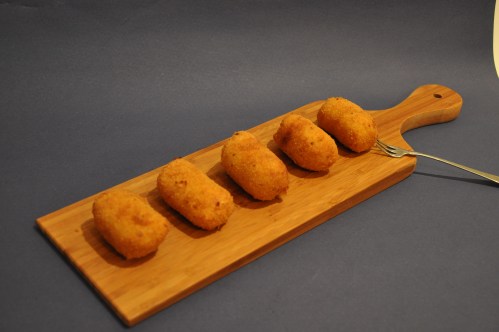
Chicken Croquettes

Chicken Croquettes

Everytime we would eat at El Comedor, among the tapas we could order, my favourite were the Croquetas de Pollo (Chicken Croquettes).  I would usually order two serves at a time, one for me and one to share with others in the table because, well, they were everyone’s favourite too!

In Madrid, the best Croquetas can be found at Lhardy.  During my last trip, I visited the tapas bar/pastry shop several times.  The most memorable time was when I bought a box of TWENTY croquetas.  I wanted to take them back to the hotel and give my husband ten of them.

On my way home I finished one and then another…. and pretty soon I had eaten the whole box!  Mortified, I rushed back to  the store to buy some more for my husband.  However, the store had run out of them already so I went back to the hotel and fessed up.

Expecting the worst, I was pleasantly surprised when my husband said that it was all fine – all he asked was that when we got back to Sydney I’d make a batch of the Croquetas using El Comedor’s recipe – he said they were just as good!  So here it is.  El Comedor’s Croquetas de Pollo.  Buen Provecho!

Ingredients

  • 4 Tablespoons oil or butter
  • 1/2 onion, minced
  • 1/4 cup plus 2 tablespoons flour
  • 250 ml milk (or you can used 125 ml milk and 125 ml chicken stock) – Note:  This should be warm, you can microwave it for a few seconds before pouring into the flour mixture
  • pinch of nutmeg
  • 1/2 teaspoon salt
  • 1/2 cup cooked chicken, finely shredded
  • 1/4 cup finely chopped ham
  • 2 beaten eggs
  • flour for dusting
  • 1 1/2 cups of breadcrumbs
  • oil for deep frying
  1. Heat the oil or butter in a saucepan and saute the minced onions until transparent over medium heat.  Do not allow them to brown.  Stir in the flour and cook briefly, then whisk in the milk a little at a time, stirring constantly (around 5 minutes to cook the flour out) until the sauce thickens.
  2. Season with the nutmeg, salt and pepper.  Stir in the cooked and chopped filling.  Spread the mixture on to a dish and refrigerate until this becomes solid.
  3. Place the beaten eggs, flour and breadcrumbs in three separate dishes.  With moistened hands, form the croquetas mixture into balls or cylinders.  Dip each one first in the flour, then egg and finally the breadcrumbs.
  4. Now you are ready to either fry them in a deep fryer (which is my preference) or a pot filled with oil at least 1/2 inch deep.  Fry them for at least 3 to 5 minutes until golden brown.

Note:  These are best eaten right after frying. If you have some left over (this recipe makes about 20 pieces), may I suggest freezing the leftover UNFRIED croquettes and frying them another time. If frozen, you can fry them straight away in a deep fryer for 5 to 7 minutes. DO NOT use a pot to fry frozen croquettes.  They will splatter too much and can be very dangerous.

Variations

  • Tuna
  • Cheese
  • Prawns
  • Mushrooms

DSC_0073

Financiers
Financiers

A frequent comment from people who meet my family for the first time will inevitably be about how much we like to talk about money.  I guess it’s a natural consequence when almost everyone in the family works for a bank or some sort of financial services company.  A typical dinner conversation will without doubt cover an analysis on the state of the global economy, a lively debate on whether interest rates are set to rise and by how much or a long-drawn out comparison between debt to equity ratios of Philippine and Australian Banks.  We even joke that my nephew’s first words after Mum and Dad were Price Earnings Ratio.

There is a story my brother in law likes to tell.  The first dinner he joined with the family we spent the first hour talking about the merits of investing in the stock market.  After awhile he asked “is the stock market all you can talk about?”… a stunned silence fell over the table.  We all looked at each other… and then spent the next hour talking about the merits of investing in the bond market!

So when I first heard about financiers, I was immediately intrigued. It sounded like a pastry that was probably invented by a French family similar to mine – always talking about money!

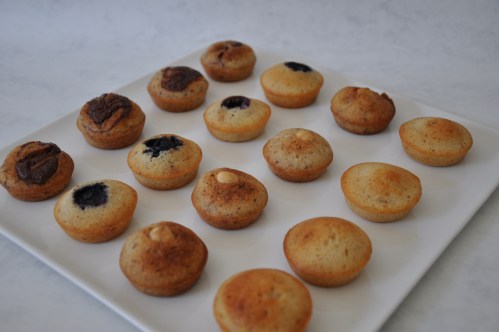
Financiers are almond cookies/tea cakes that are made from almond meal, butter, sugar and flour.  They derive their name from the traditional rectangular mold which is supposed to resemble a bar of gold.  Dorie Greenspan, who I got this recipe from, mentions in her book (Paris Sweets) that financiers were invented by a pastry chef in the late nineteenth century named Lasne whose shop was near the Paris Stock Exchange.  He invented them so that they could be eaten on the run without a knife, fork or spoon and completely without risk to suit, shirt, or tie.

I unfortunately did not have the financier mold to use but a mini-muffin pan is perfectly acceptable.

The key to this tasty treat is the beurre noisette (burnt butter).  That gives the financiers its rich nutty flavour.  My tip is that you MUST WATCH THE BUTTER VERY CAREFULLY.  There is only a few seconds between the beurre noisette and rancid black butter!  To know when the butter is done, my tip is to wait a few seconds after the butter stops “bubbling” and you see bits of browned sediment at the bottom of the pan.  Use a stainless steel pan, not something with a teflon coating, otherwise you won’t be able to see the sediments.

This recipe has been adapted from Dorie Greenspan’s Paris Sweets.

Ingredients

  • 180 grams unsalted butter (6 ounces or 1 1/2 sticks)
  • 200 grams sugar (1 cup)
  • 100 grams almond meal (1 cup)
  • 6 large egg whites
  • 90 grams all purpose flour

Procedure

  1. Put the butter in a small saucepan and bring it to the boil over medium heat, swirling the pan occasionally.  Allow the butter to bubble away until it turns a deep brown, but don’t turn your back on the pan – the difference between brown and black is measured in seconds.  Pull the pan from the heat and keep it in a warm place.
  2. Mix the sugar and almonds together in a large saucepan.  Stir in the egg whites, place the pan over low heat, and, stirring constantly with a wooden spoon, heat the mixture until it is runny, slightly white, and hot to the touch, about 2 minutes.  Remove the pan from the heat and stir in the flour, then gradually mix in the melted butter.  Transfer the batter to a bowl, cover with plastic wrap, pressing it against the surface of the batter to create an airtight seal, and chill for at least 1 hour.  (The batter can kept covered in the refrigerator for up to 3 days).
  3. Center a rack in the oven and preheat the over to 200C (400F).  Butter the molds (I think I managed to make 32 financiers with this recipe but can’t be sure if some people swiped a few while I wasn’t looking), dust the interiors with flour, and tap out the excess.
  4. Fill each mold almost to the top with batter (if using mini muffin pans a tablespoonful will do).  Bake in the over for 13 to 15 minutes (book says 12 to 13 minutes) or until the financiers are golden, crowned and springy to the touch.  If necessary, run a blunt knife between the cookies and the sides of the pans, then turn the cookies out of their molds and allow them to cool to room temperature right side up on cooling racks.

Note:  Although the batter can be kept in the refrigerator for up to 3 days, financiers are best enjoyed the day they are baked.

Variations:

  • I added a blueberry on some of the almond financiers
  • I substituted almond meal for hazelnut meal for one batch and mixed with nutella
Korean Beef Stew

Korean Beef Stew

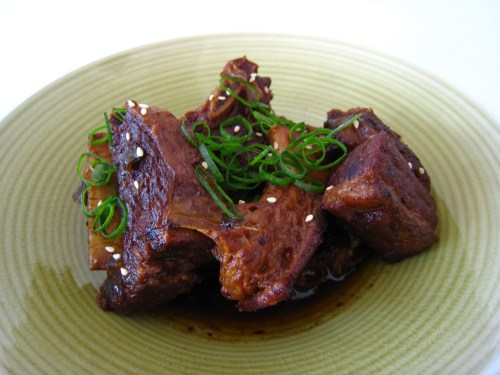
Of all the stews I make, this is my husband’s ABSOLUTE FAVORITE.  I love it too because it is so easy to make.  You fry of some beef ribs, pour over the rest of the ingredients.  Forget about it for around two hours while you do the house chores or  read a book.  Come back when the meat is tender and falling off the bone, garnish with toasted sesame seeds and spring onions and serve with a big bowl of rice.

This recipe serves 4

Ingredients

  • 1 kilo beef ribs
  • 2 tablespoons vegetable oil
  • 2 tablespoons dark soy sauce
  • 2 teaspoons sesame oil
  • 3 spring onions, chopped
  • 4 cloves garlic, crushed
  • 1 tablespoon grated ginger
  • 2 tablespoons brown sugar
  • 2 tablespoons Japanese rice wine
  • 2 cups water
  • 1 tablespoon toasted sesame seeds to serve
  • 1 spring onion, chopped to serve
  • 1 tablespoon cornstarch diluted in 2 tablespoons cold water

Season the beef ribs with salt and pepper and fry the pieces in batches a pot with the oil.  It is best not to overcrowd the pot, otherwise you won’t sear the meat and get a nice golden brown color.   Once done, throw in the rest of the ingredients above up to and including the 2 cups of water (the idea is to cover the beef in the braising liquid).  Bring to a boil and skim off any scum that rises to the top of the pot.  Lower the heat to a simmer and cook uncovered for 2 hours or until the beef is tender and falling off the bone.

To thicken the sauce, add the cornstarch which has been diluted in cold water when the ribs are done.

Garnish with toasted sesame seeds and the chopped spring onions.

Note:  Another variation is to add chopped radish (1 inch in size)  and spinach and cook around five minutes prior to finishing the beef.

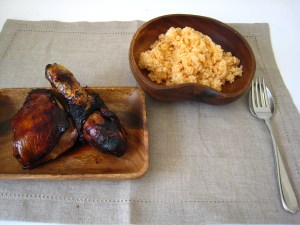
Chicken Barbecue and Java Rice

Chicken Barbecue and Java Rice

Inspired by the beautiful posts from Trish at Sugarlace, I’ve attempted to make a very typical Filipino dish.  We used to have this at a restaurant in the Philippines called Alex III and occasionally for Sunday lunch at my grandmother’s house.  Another version of this dish is to cut up pork belly or shoulder and marinate overnight in the recipe below.  The next day, thread the pork pieces on pre-soaked bamboo skewers and grill.

This dish is traditionally served with  pickled vegetables, Philippine Style called Atchara.

Chicken Marinade – serves 6

  • 12 chicken thighs (or a combination of thighs and drumsticks)
  • 1 can of sprite
  • 1 cup dark soy sauce
  • 1/2 cup brown sugar
  • 6 cloves of crushed garlic
  • salt and pepper

Marinate the chicken pieces in the refrigerator for at least 2 hours or overnight if possible.  When ready to cook, bake the chicken in a 180c oven for 40 minutes.  The reason I do this is because the marinade contains a lot of sugar, pre-baking the dish ensures that the pieces are cooked prior to grilling.  Grilling without pre-baking may result in burned chicken pieces! If you are not grilling the chicken after, continue to bake for another 20 to 30 minutes until the pieces are thoroughly cooked.

If grilling the chicken, fire up the barbecue and grill for around 10 to 15 minutes.  Baste the chicken pieces frequently with the leftover marinade.

Java Rice – serves 6

  • 6 cups cooked rice (cooked a day earlier and left in the refrigerator to cool)
  • 3 tablespoons peanut oil
  • 6 cloves crushed garlic
  • 1/4 cup light soy sauce
  • 1/4 cup tomato sauce (ketchup)

For the rice, heat the oil in a large work and add the crushed garlic until fragrant (around 30 seconds).  Add the salt and pepper and then the rice.  Fry the rice for a few minutes, making sure to separate the grains with the back of a wooden.  spoon.  To finish, add the soy sauce and ketchup and fry for another two to three minutes.

Chicken Barbecue and Java Rice

Dobos Torta

Dobos Torta

034

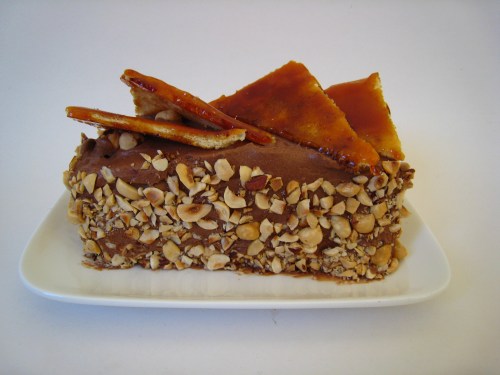
SINCE when does DO NOT TOUCH mean YES, GO AHEAD, EAT IT ALL!?!?  Well, apparently, if it is 1:00 am in the morning and you come home craving for something sweet!  This is exactly what happened this evening (or early morning).  My worst worst nightmare.  Last night I rushed home to bake this month’s Daring Bakers’ challenge (already a day late!) and had assembled a little cake  to photograph the next day.

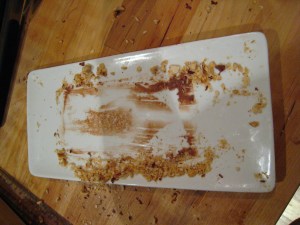
Husband comes home at 1:00 am from a very late night at work and decides to raid the refrigerator for something sweet.  And although I had placed a post-it note on top of the cake saying DO NOT TOUCH… well, you know what happens.  I get up this morning to shoot the cake and I find it GONE.  Well, not entirely true, there is a little buttercream left on the plate… but no more cake.

Where did the cake go?!!?

Where did the cake go?!!?

LUCKILY… I still have a few scraps of the cake left over and have some left over butter I have forgotten to bring back into the refrigerator last night and I decide to make another batch of buttercream and use whatever leftover cake I have.  This is at 6:00 AM!

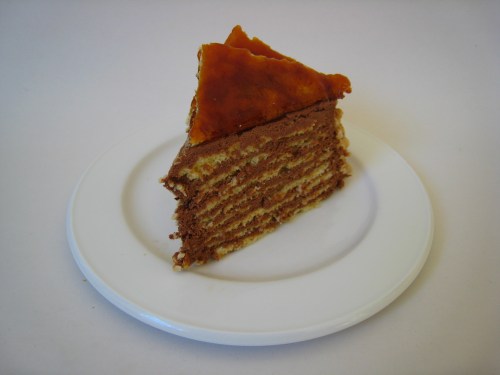
So here it is, this month’s Daring Bakers’  Challenge – the almost “re-incarnation” of the first Dobos Torte I made.

The August 2009 Daring Bakers’ challenge was hosted by Angela of A Spoonful
of Sugar
and Lorraine of Not Quite Nigella. They chose the spectacular Dobos
Torte based on a recipe from Rick Rodgers’ cookbook Kaffeehaus:  Exquisite
Desserts from the Classic Caffés of Vienna, Budapest, and Prague.

Dobos Torta

Recipe adapted from Kaffehauss by Rick Rodgers and Cafe Chocolada.

Sponge cake layers

  • 6 large eggs, separated, at room temperature
  • 1 1/3 cups (162g) confectioner’s (icing) sugar, divided
  • 1 teaspoon (5ml) vanilla extract
  • 1 cup plus 2 tablespoons (112g) sifted cake flour (SUBSTITUTE 95g plain flour + 17g cornflour (cornstarch) sifted together)
  • pinch of salt

Chocolate Buttercream

  • 4 large eggs, at room temperature
  • 1 cup (200g) caster (ultrafine or superfine white) sugar
  • 4oz (110g) bakers chocolate or your favourite dark chocolate, finely chopped
  • 2 sticks plus 2 tablespoons (250g) unsalted butter, at room temperature.

Caramel topping

  • 1 cup (200g) caster (superfine or ultrafine white) sugar
  • 12 tablespoons (180 ml) water
  • 8 teaspoons (40 ml) lemon juice
  • 1 tablespoon neutral oil (e.g. grapeseed, rice bran, sunflower)

Finishing touches

  • a 7” cardboard round
  • 12 whole hazelnuts, peeled and toasted
  • ½ cup (50g) peeled and finely chopped hazelnuts

Directions for the sponge layers:

NB. The sponge layers can be prepared in advance and stored interleaved with parchment and well-wrapped in the fridge overnight.

1.Position the racks in the top and centre thirds of the oven and heat to 400F (200C).
2.Cut six pieces of parchment paper to fit the baking sheets. Using the bottom of a 9″ (23cm) springform tin as a template and a dark pencil or a pen, trace a circle on each of the papers, and turn them over (the circle should be visible from the other side, so that the graphite or ink doesn’t touch the cake batter.)
3.Beat the egg yolks, 2/3 cup (81g) of the confectioner’s (icing) sugar, and the vanilla in a medium bowl with a mixer on high speed until the mixture is thick, pale yellow and forms a thick ribbon when the beaters are lifted a few inches above the batter, about 3 minutes. (You can do this step with a balloon whisk if you don’t have a mixer.)

4.In another bowl, using clean beaters, beat the egg whites until soft peaks form. Gradually beat in the remaining 2/3 cup (81g) of confectioner’s (icing)sugar until the whites form stiff, shiny peaks. Using a large rubber spatula, stir about 1/4 of the beaten whites into the egg yolk mixture, then fold in the remainder, leaving a few wisps of white visible. Combine the flour and salt. Sift half the flour over the eggs, and fold in; repeat with the remaining flour.002
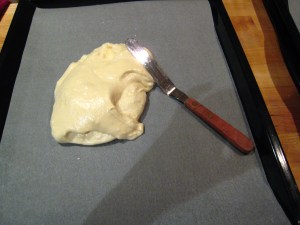
5.Line one of the baking sheets with a circle-marked paper. Using a small offset spatula, spread about 3/4cup of the batter in an even layer, filling in the traced circle on one baking sheet. Bake on the top rack for 5 minutes, until the cake springs back when pressed gently in the centre and the edges are lightly browned. While this cake bakes, repeat the process on the other baking sheet, placing it on the centre rack. When the first cake is done, move the second cake to the top rack. Invert the first cake onto a flat surface and carefully peel off the paper. Slide the cake layer back onto the paper and let stand until cool. Rinse the baking sheet under cold running water to cool, and dry it before lining with another parchment. Continue with the remaining papers and batter to make a total of six layers. Completely cool the layers. Using an 8″ springform pan bottom or plate as a template, trim each cake layer into a neat round. (A small serrated knife is best for this task.)

Directions for the chocolate buttercream:

NB. This can be prepared in advance and kept chilled until required.

1.Prepare a double-boiler: quarter-fill a large saucepan with water and bring it to a boil.
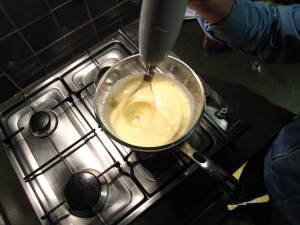
2.Meanwhile, whisk the eggs with the sugar until pale and thickened, about five minutes. You can use a balloon whisk or electric hand mixer for this.005
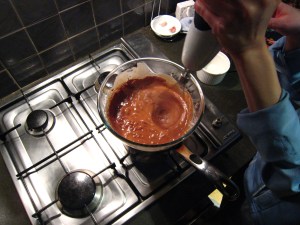
3.Fit bowl over the boiling water in the saucepan (water should not touch bowl) and lower the heat to a brisk simmer. Cook the egg mixture, whisking constantly, for 2-3 minutes until you see it starting to thicken a bit. Whisk in the finely chopped chocolate and cook, stirring, for a further 2-3 minutes.006
4.Scrape the chocolate mixture into a medium bowl and leave to cool to room temperature. It should be quite thick and sticky in consistency.
5.When cool, beat in the soft butter, a small piece (about 2 tablespoons/30g) at a time. An electric hand mixer is great here, but it is possible to beat the butter in with a spatula if it is soft enough. You should end up with a thick, velvety chocolate buttercream. Chill while you make the caramel topping.

Lorraine’s note: If you’re in Winter just now your butter might not soften enough at room temperature, which leads to lumps forming in the buttercream. Male sure the butter is of a very soft texture I.e. running a knife through it will provide little resistance, before you try to beat it into the chocolate mixture. Also, if you beat the butter in while the chocolate mixture is hot you’ll end up with more of a ganache than a buttercream!

Directions for the caramel topping:

1.Choose the best-looking cake layer for the caramel top. To make the caramel topping: Line a jellyroll pan with parchment paper and butter the paper. Place the reserved cake layer on the paper. Score the cake into 12 equal wedges. Lightly oil a thin, sharp knife and an offset metal spatula.
2.Stir the sugar, water and lemon juice in a small saucepan. Bring to a boil over a medium heat, stirring often to dissolve the sugar. Once dissolved into a smooth syrup, turn the heat up to high and boil without stirring, swirling the pan by the handle occasionally and washing down any sugar crystals on the sides of the pan with a wet brush until the syrup has turned into an amber-coloured caramel.
3.The top layer is perhaps the hardest part of the whole cake so make sure you have a oiled, hot offset spatula ready. I also find it helps if the cake layer hasn’t just been taken out of the refrigerator. I made mine ahead of time and the cake layer was cold and the toffee set very, very quickly—too quickly for me to spread it. Immediately pour all of the hot caramel over the cake layer. You will have some leftover most probably but more is better than less and you can always make nice toffee pattern using the extra to decorate. Using the offset spatula, quickly spread the caramel evenly to the edge of the cake layer. Let cool until beginning to set, about 30 seconds. Using the tip of the hot oiled knife (keep re-oiling this with a pastry brush between cutting), cut through the scored marks to divide the caramel layer into 12 equal wedges. Cool another minute or so, then use the edge of the knife to completely cut and separate the wedges using one firm slice movement (rather than rocking back and forth which may produce toffee strands). Cool completely.

Angela’s note: I recommend cutting, rather than scoring, the cake layer into wedges before covering in caramel (reform them into a round). If you have an 8” silicon round form, then I highly recommend placing the wedges in that for easy removal later and it also ensures that the caramel stays on the cake layer. Once set, use a very sharp knife to separate the wedges.

Assembling the Dobos

1.Divide the buttercream into six equal parts.
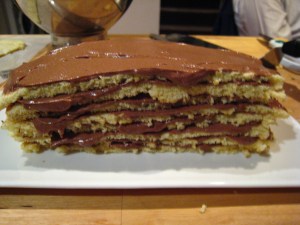
2.Place a dab of chocolate buttercream on the middle of a 7 1/2” cardboard round and top with one cake layer. Spread the layer with one part of the chocolate icing. Repeat with 4 more cake layers. Spread the remaining icing on the sides of the cake. 009
3.Optional: press the finely chopped hazelnuts onto the sides of the cake.
4.Propping a hazelnut under each wedge so that it sits at an angle, arrange the wedges on top of the cake in a spoke pattern. If you have any leftover buttercream, you can pipe rosettes under each hazelnut or a large rosette in the centre of the cake. Refrigerate the cake under a cake dome until the icing is set, about 2 hours. Let slices come to room temperature for the best possible flavour.

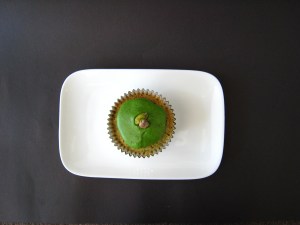
Warm Pistachio Cupcakes

Warm Pistachio Cupcakes

Being a cupcake is tough.  There are so many cupcakes out there – it is so hard to make a difference.  So when I heard that Kath from a cupcake or two was hosting a competition to win a cupcake courier it with great consideration that I provided my entry.  Basically, the best cupcake recipe wins!  Well, whether I win or not, I think these cupcakes are winners on their own!

Let me warn you, they aren’t your typical cupcakes. It contains a dash of kirsch, it is simply decorated and when you bite into it you will realize you are eating a more “grown-up” version of the cupcake.  Also, they are gluten free – which is a plus!

The recipe is from Shannon Bennett (Vue de Monde Restaurant) in his book My French Vue, Bistro Cooking at Home.  He mentions in his book that these cupcakes account for 70% of all the cakes they sell!  He decided to part with the recipe so his regular clientele would make it at home and try the other desserts they make at Bistro Vue.

Here’s the recipe:

Warm Pistachio Cupcakes

Ingredients

  • 100 grams unsalted butter, softened
  • 85 grams caster sugar
  • pinch of salt
  • 20 grams sweetened pistachio paste (I used regular pistachio paste from a healthfood store)
  • 55 grams marzipan (minimum 50% nuts)
  • 2 medium sized eggs
  • 100 grams unsalted pistachios, ground
  • 30 grams unsalted pistachios, shelled and rough chopped
  • 20 ml kirsch
  • 2 drops vanilla essence
  • 30 grams semolina
  • 12 patty pan cases
  • 12 whole pistachios, shelled

Fondant Icing

  • 200 grams icing sugar, sifted
  • 2 tablespoons water
  • 40 grams pistachio paste
  1. Preheat a fan forced over to 165c.
  2. For this recipe, I recommend using a beater with a paddle attachment.  You can make the mixture by hand, though, using a wooden spoon and a metal mixing bowl.
  3. Put the butter, sugar, salt, pistachio paste and chopped marzipan into the bowl and beat well until lumps are removed and you have a smooth paste.   Add the eggs one at a time, beating continuously and ensuring the mix does not stick to the side of the bowl, until eggs are thoroughly amalgamated.
  4. Add the ground and rough chopped nuts and continue to beat.  Then beat in the kirsch, vanilla and semolina.

    The ever loyal Baci waiting for a little snack!

    The ever loyal Baci waiting for a little snack!

  5. Lay out medium-size patty pan cases.  Using a piping bag or spoon, place the mix into the cases equally.  This should be about 50 grams of mixture per case.  Note:  For some reason, I was only able to manage 10 cupcakes.    189
  6. Put the cakes onto an oven tray and bake for approximately 16 minutes, then remove from the over and allow to cool on the tray.
  7. Make icing: whisk together all ingredients to make a smooth paste.  Put it into a clean pan and gently heat, stirring continuously with a wooden spoon, to approximately blood temperature then spoon over the cakes in equal measure.  Place a whole pistachio (or two!) on top of the warm fondant.
  8. Reheat cupcakes in a warm over for 2 minutes before serving.

207

Julia Child's Vegetable Gateau

Julia Child's Vegetable Gateau

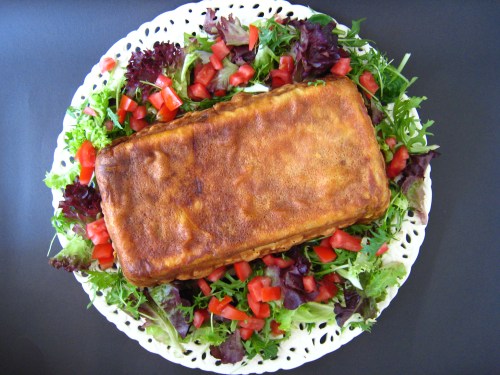
Spring on a plate!

Spring on a plate!

The weather here in Sydney is finally turning!  With warmer weather just around the corner, it’s great to be able to prepare dishes that sing of spring.  For me, that usually means lighter meals, and more vegetables.  This dish embodies spring time – it can be eaten cold, as part of a salad and is just so pretty and colorful to look at!

I took this recipe from my Mom who adapted it from Julia Child’s cookbook called Julia Child & More Company.  Simply put, it is a molded mountain of crepes layered with vegetables and cheese.  If I may give you one tip, plan ahead.  This dish has many components and one can easily think to give up after seeing the 17 or so ingredients.  But if you take your time in preparing this dish you will be handsomely rewarded.  Trust me.  If there was one dish that would convert me into a semi-vegetarian – this would be it!

Ingredients

For the crepe batter

  • 1 cup flour
  • 2/3 cup milk
  • 2/3 cup water
  • 3 eggs
  • 1/4 teaspoon salt
  • 3 tablespoons melted butter

Vegetables and Cheese for Filling

  • 450 grams carrots
  • 8 to 8 tablespoons butter
  • salt and pepper
  • 450 grams fresh mushrooms
  • 4 tablespoons shallots
  • 500 grams fresh broccoli
  • 2 cups shredded grated Swiss cheese

Custard Mixture for Filling

  • 1 cup (225 grams cream cheese at room temperature)
  • 6 large eggs
  • 1 cup heavy cream
  • salt and pepper
  • a pinch of fresh nutmeg to taste

Equipment:

  • Crepe pan
  • 1 loaf tin (Julia uses an 8 cup/2 litre baking dish such as a charlotte mold, 4 inches deep)

Procedure

The Crepes

Pour the flour into a bowl.  Blend the milk and water into the flour, beating with a whip until smooth, then beat in the eggs, salt and butter.  Let rest for an hour or two so that the flour granules can absorb the liquid – making a tender crepe.

The Crepes – cooking

To cook the crepes, heat the frying pan or pans until drop of water sizzle on the surface.   Brush lightly with a little butter (usually only necessary for the first crepe), and pour 2 to 3 tablespoons or so of the batter into the center of the pan, turning the pan in all directions as you do so to spread the batter over the bottom surface.  Cook for 30 seconds or so, until you see, when you lift an edge, that it is nicely browned.  Turn and cook for 15 seconds more.  Arrange the crepes as they are made on a cake rack so they will cool and dry off for 5 minutes or so.  When dry, stack together, wrap in foil and place in a plastic bag.

*Note: Crepes will keep for 2 to 3 days in the refrigerator.  To freeze, it is best to package them in stacks of 6 or 8; either thaw at room temperature, or unpackage and heat in a covered dish in a moderate over for 5 minutes or until they separate easily.

Preparing the vegetables

Trim and peel the carrots, and cut into julienne matchsticks.  Saute in 1 1/2 tablespoons butter in a large frying pan, swirling and tossing frequently until carrots are nicely tender and being careful not to brown them.  Season well with salt and pepper.  Set aside.

Trim and wash the mushrooms, and cut into a fine mince.  Saute in the same large frying pan along with the shallots until the liquid from the mushrooms evaporates (around 10 minutes).  Season with salt and pepper and set aside in another bowl.

Trim and wash the broccoli.  Cut bud ends off stalks to make them about 2 inches long.  Starting at the cut ends, peel as much skin off as you easily can; peel skin of stalks cutting down to expose the tender whitish flesh, then cut into pieces half the length of your little finger to ensure quick and even cooking.  Drop the peeled stalks and florets into rapidly boiling salter water and boil uncovered for 3 to 5 minutes.  Drain immediately and chop into piece about 1/4 inch in size.  Toss briefly in 2 tablespoons hot butter and salt and pepper to taste.  Set aside.

The vegetables can be cooked a day ahead.  Cover and refrigerate until ready to use.
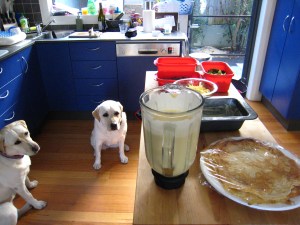
My little helpers giving moral support!

My little helpers giving moral support!

The Custard Mixture

Blend the cream cheese with the rest of the custard ingredients in a blender or food processor until smooth.

To Assemble

Preheat the over to 180c.  Smear some butter over the inside of the baking tin and line the bottom of the dish with buttered wax paper.  Fit 1 crepe (good side down) in the bottom of the dish and space 4 around the sides.

Spread 1/4 of the grated cheese in the bottom of the dish, cover with the carrots and pressing them well in place, and top with 1/3 of the remaining cheese.  Ladle in enough custard mixture to come just to the level  of the carrots and cheese.

The carrot layer being assembled

The carrot layer being assembled

Arrange 1 crepe on top, and spread over it the mushrooms and another ladleful of custard.
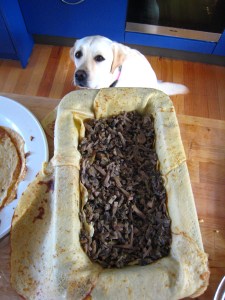
The mushroom layer with Baci watching closely

The mushroom layer with Baci watching closely

Arrange 1 or more crepes over the mushrooms and spread 1/2 of the remaining cheese, then broccoli and the final bit of cheese.
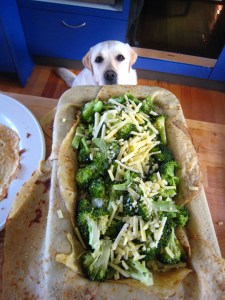
The broccoli layer - Baci... still watching

The broccoli layer - Baci... still watching

Pour on the last of the custard mixture and fold the first layer of overhanging crepes up over the filling; cover with a crepe and fold the first layer of overhanging crepes up over the filling; cover with a crepe and fold the outside layer of overhang up over it, and cover with 1 or more crepes.  Place a round of buttered wax paper over the dish, and cover with a sheet of foil.

Bake the gateau immediately in case the custard leaks against the sides and bottom of the dish, sticking the crepes to it and making a mess later when you attempt to unmold!

*Note: I only used a loaf pan which was considerably smaller than the baking dish Julia recommended.  As such, there was some leftover custard and vegetables.  Never mind, the idea is that you layer the dish with cheese, vegetables, custard and then the crepe.  Except for the mushrooms which is just custard and mushrooms.  If using a loaf pan, you will also have leftover custard and I had some left over vegetables to make sure that my loaf pan did not overfill.

Baking using the 8 cup baking dish

This will take around 1 3/4 hours.  Bake on lower middle rack in a preheated oven, placing a pan below the dish in case some of the custard filling dribbles.  In about 1 hour, when the gateau has started to rise, turn oven up to 205C.  It will eventually rise and inch or more and is done when a meat thermometor reads 71c.   Remove from the oven and let rest at room temperature for around 20 to 30 minutes allowing the custard to set and settle.  Then run a thin blade knife carefully around the inside of the dish, and unmold.

Baking using the loaf pan

This will take around 1 hour.  Bake on the lower middle rack in a preheated oven.  After an hour, turn the oven off and leave the gateau to rest for 10 minutes.  Remove from the oven and let rest at room temperature for 20 to 25 minutes, allowing the custard to set and settle.  Then run a thin blade knife carefully around the inside of the dish and unmold.

Surround the gateau with lettuce leaves and fresh tomatoes.
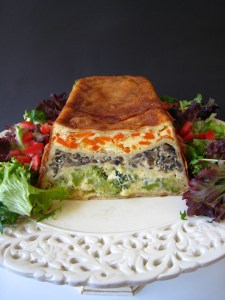
Makes a delicious cold dish as well!

Makes a delicious cold dish as well!